Rekha Shenoy - Episode 179 - The Route to Networking
22 Sept, 2026


Why the Ocean Could Change Where Data Centers Are BuiltIn our previous article, we looked at...

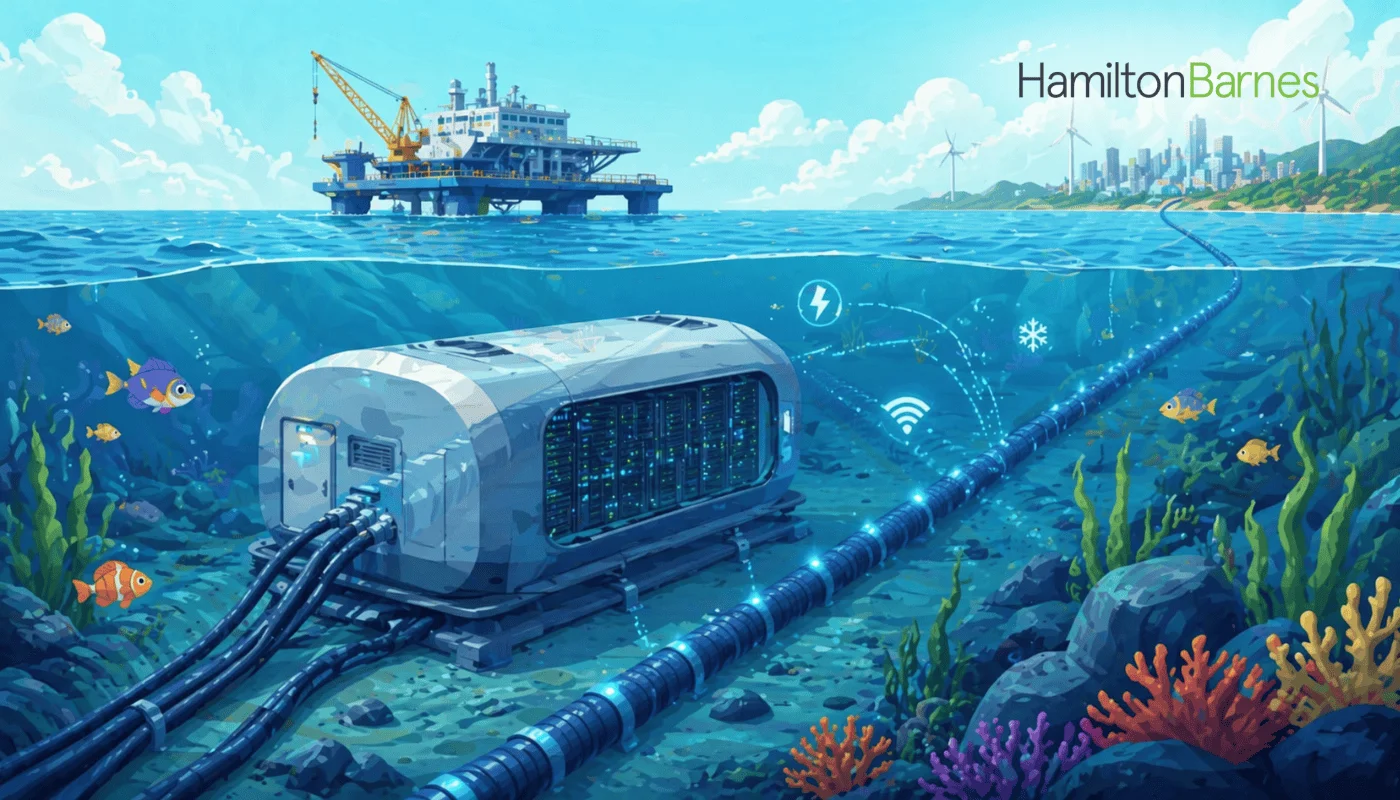
In our previous article, we looked at something most people never think about. The infrastructure beneath the ocean. The subsea systems and energy models quietly supporting the internet, read full article here.
That piece was about visibility. Understanding what already exists.
But after speaking with Nathaniel Harmon, Co-Founder and CEO of OceanBit, on The Route to Networking Podcast, it felt like we’d only scratched the surface.
Because once you start to understand how energy can be generated offshore, and how data already moves globally through subsea networks, a different thought starts to form.
Not about the technology itself.
But about the decisions we’ve made around it.
It got us thinking less about what’s possible, and more about why the industry is still structured the way it is.
There’s an assumption baked into almost every data center conversation.
Infrastructure belongs on land.
It sounds obvious. It’s how it’s always been done. Close to cities, close to users, close to existing power.
But when you break it down, that assumption starts to feel less solid.
Because data centers don’t actually need proximity in the way other industries do.
They don’t need foot traffic.
They don’t need physical access.
They need power. They need cooling. They need connectivity.
And increasingly, those things are becoming harder to secure in the environments we’ve chosen.
At the same time, we’re seeing more projects delayed, more pressure on grids, and more complexity in planning.
So the question isn’t whether demand is growing.
It’s whether the model we’re using to meet it still makes sense.
A lot of the industry conversation today focuses on scale.
But speaking with Nathaniel, it felt like we might be solving the wrong problem.
Because the issue isn’t always the availability of energy.
It’s where that energy sits, and how we’re trying to connect it to infrastructure.
“Infrastructure moves at the speed of infrastructure,” he said.
And right now, that speed is being dictated by land-based constraints.
All of which take time.
So instead of trying to force more into that system, what happens if you step outside of it?
This is where the conversation shifts.
In the previous article, we explored how energy can be generated offshore, and how data can move freely through subsea networks.
But the real implication of that isn’t just technical.
It’s strategic.
Because if energy exists in one place, and data can move anywhere, then infrastructure doesn’t need to be anchored in the way it is today.
It can move.
Not everywhere. Not overnight.
But enough to change how we think about scale.
Nathaniel described early thinking around this in simple terms. If you have access to consistent energy, you can deploy compute directly against it.
“You just plug in computers and feed it electricity… and it generates revenue.”
That idea started with things like Bitcoin mining.
But the same principle applies far more broadly now.
One part of the conversation that stuck with us was how casually cooling came up.
Because it’s often treated as a secondary challenge.
But in reality, it shapes a huge amount of how data centers are designed and operated.
And on land, it’s expensive, complex, and increasingly inefficient at scale.
Offshore, it isn’t.
“You’ve got unlimited and free cooling available.”
That’s not just a technical advantage.
It’s a structural one.
It removes a layer of complexity that the industry has spent years trying to optimise around.
What makes this shift interesting is that we’ve seen it before.
Not in data centers.
But in energy.
There was a time when offshore was seen as too difficult. Too risky. Too expensive to justify.
Until demand forced a change.
Nathaniel made that comparison directly, and it’s hard to ignore the parallels.
“There’s this pervasive myth that working offshore is more expensive… but it’s just not true.”
And it raises a fair question.
Are we at a similar moment now in digital infrastructure?
None of this suggests that data centers are about to disappear from land.
That’s not realistic.
But it doesn’t need to be.
Even a shift in how new capacity is deployed would change the dynamic.
If certain workloads move closer to energy sources
If high-density compute sits offshore
If new builds aren’t constrained by the same limitations
Then the system becomes more flexible.
And the pressure we’re seeing today starts to ease.
This is where the conversation really landed for us.
Because once you remove the assumption that infrastructure has to sit on land, a lot of other questions start to follow.
Nathaniel’s perspective is that if you start with energy, everything else begins to align around it.
And if that’s the case, then the bigger question becomes:
Are we about to see a shift in where digital infrastructure is built?
Or are we still too early for that to happen?
Hamilton Barnes supports organizations and professionals across the global data center and digital infrastructure market, helping businesses navigate the challenges of scaling, hiring, and delivery.
We work closely with companies across networking, fibre, telecommunications, and data center infrastructure to secure the talent needed across engineering, construction, and operations. As the industry continues to evolve, we help businesses build the teams required to deliver, and support professionals in positioning themselves within a fast-moving and increasingly complex market.
We also support candidates with CV guidance, interview preparation, and long-term career planning, helping you position yourself in a fast-moving and competitive market.
If you’re looking to discuss your hiring plans or explore your next career move, our team is always available for a conversation.
Want to hear more from the Route to Networking podcast?
Why are data centers being considered offshore?
Rising pressure on power, land, and cooling is pushing the industry to explore alternative locations.
What makes the ocean suitable for infrastructure?
It offers access to energy, natural cooling, and fewer traditional constraints compared to land.
Is this already happening?
There are early-stage projects and pilots exploring offshore and underwater data centers.
How does this relate to subsea cables?
Subsea networks already enable global data transfer, making it easier to separate compute from traditional locations.
Will this replace traditional data centers?
No, but it could become an important part of how future infrastructure is designed.