8 US Data Center Operators Driving AI Infrastructure
25 Sept, 2026


What Actually Gets a Data Center Project Funded?Looking Inside the DecisionIn our previ...

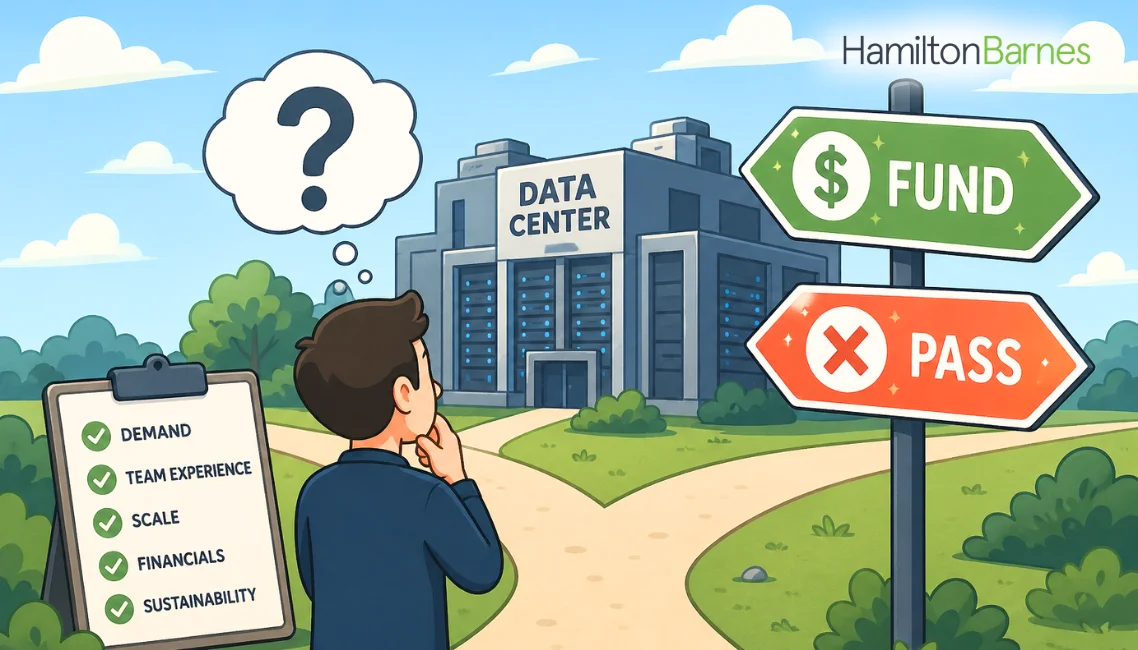
Looking Inside the Decision
In our previous article, we looked at how capital is flowing into the data center market, and why investment is accelerating so quickly.
But that only tells part of the story.
Because while billions are being committed globally, not every project gets funded. Not every development moves forward. And not every market attracts the same level of attention.
In this episode of The Route to Networking, Obinna Isiadinso, Global Sector Lead for Data Center Investments at the International Finance Corporation, part of the World Bank Group, offered a useful perspective on what actually sits behind those decisions.
Not the headlines.
But the filters.
The reality is, before any capital is deployed, projects go through a fairly unforgiving lens. And understanding that lens tells you a lot about where the industry is heading.
We wanted to understand that properly. What investors are actually looking for, where projects fall down, and what separates the ones that move forward from the ones that don’t.
A lot of conversations in this space are still built around potential.
New markets. Growth forecasts. Future demand.
But from an investment perspective, that’s not where decisions are made.
As Obinna put it, “we need to be comfortable with the market… the supply demand dynamics.”
That’s a very different mindset.
Because demand in this market is not evenly spread. It’s driven by a small number of very specific customers, often hyperscalers, who need capacity in very specific locations. If those customers aren’t already there, or not contractually tied in, the project becomes much harder to justify.
This is why capital doesn’t flow evenly across regions.
It follows demand, not potential.
And that’s a key distinction that often gets missed.
To understand why these filters are so strict, you have to look at the scale of what’s being funded.
This isn’t incremental investment anymore.
Global data center capex is growing at a pace that’s hard to compare to anything else in infrastructure. Spending increased by over 50% in 2025 alone, with forecasts suggesting it could exceed $1 trillion annually in the coming years.
At the same time, hyperscalers are projected to spend well over $500 billion a year on AI and data center infrastructure.
And over a longer horizon, total investment could reach $7 trillion by 2030.
That level of capital changes everything.
It raises the stakes on every decision. It increases the consequences of getting it wrong. And it means investors are far more selective about where that money goes.
Another theme that came through clearly is how much weight is placed on the team behind a project.
Data centers are not speculative assets. They are operationally complex, high-stakes environments where failure is not an option.
As Obinna explained, “this is mission critical infrastructure.”
That shifts how investors think.
They are not just funding a build. They are backing a team’s ability to deliver uptime, maintain performance, and meet strict customer requirements over the long term.
In practical terms, that means:
Without those, projects don’t just become risky.
They often don’t get funded at all.
One of the less obvious, but more important shifts is how scale is now influencing decision-making.
As discussed in the first article, project sizes have increased significantly. But what that means in practice is that expectations have increased alongside them.
Larger projects require:
This naturally reduces the number of viable projects.
At the same time, it concentrates capital into fewer, larger developments.
So while the industry is growing, access to that growth is becoming more limited.
Another factor that is increasingly shaping investment decisions is sustainability.
Not as a branding exercise, but as part of the core financial case.
Investors are now looking closely at:
This is partly driven by regulation, but also by economics. Inefficient assets become more expensive to operate over time, and therefore less attractive to both customers and investors.
As Obinna highlighted, this is now embedded into how projects are assessed from the outset.
It’s no longer something added later.
It’s part of the decision.
When you put all of this together, it becomes clearer why some projects stall early.
It’s rarely one big issue.
More often, it’s a series of smaller gaps:
From the outside, it can look like hesitation.
In reality, it’s discipline.
Because in a market where billions are being deployed, the cost of getting it wrong is too high.
Our previous article was about how much money is entering the market, this is about how that money is being filtered.
And the takeaway is pretty clear.
This is not a market where capital is freely available to anyone with a good idea.
It’s a market where capital is concentrated around certainty.
And that has a wider implication.
As more money flows into the industry, it doesn’t necessarily make it easier to enter.
In many ways, it makes it harder.
Because the more capital involved, the more selective it becomes.
The industry is still growing. Demand is still accelerating. And capital is still flowing in at scale.
But the way that capital is being deployed is becoming more structured, more disciplined, and more concentrated.
Which raises a bigger question.
If the market continues to scale at this pace, does it become increasingly dominated by a smaller number of players?
Or does new capital create room for new entrants to compete?
That’s the part that’s still playing out.
Hamilton Barnes supports organizations and professionals across the US data center and digital infrastructure market, helping businesses navigate the challenges of scaling, hiring, and delivery.
We work closely with data center developers, operators, and infrastructure providers to secure the talent needed across engineering, construction, and operations.
You can learn more about our work across data centre recruitment solutions and telecommunications recruitment.
For professionals, we provide access to opportunities across data centers, networking, and infrastructure, alongside guidance on how to position yourself in a rapidly evolving market.
Browse current data center roles.
We also support candidates with CV advice, interview preparation, and career planning through our candidate support and career advice resources.
If you would like to speak with our team about your hiring plans or career goals, you can get in touch directly.
Want to hear more from the Route to Networking podcast?
What determines whether a data center project gets funded?
Strong demand, experienced teams, and alignment with market and sustainability expectations.
Why is demand more important than potential?
Because investors prioritise committed customers over future forecasts.
How much is being invested in data centers globally?
Hundreds of billions annually, with projections reaching over $1 trillion per year in the near future.
Why are projects becoming more selective?
Larger project sizes and higher capital requirements mean fewer viable opportunities.
What does this mean for new entrants?
It’s becoming harder to break in without experience, capital, or strong partnerships.