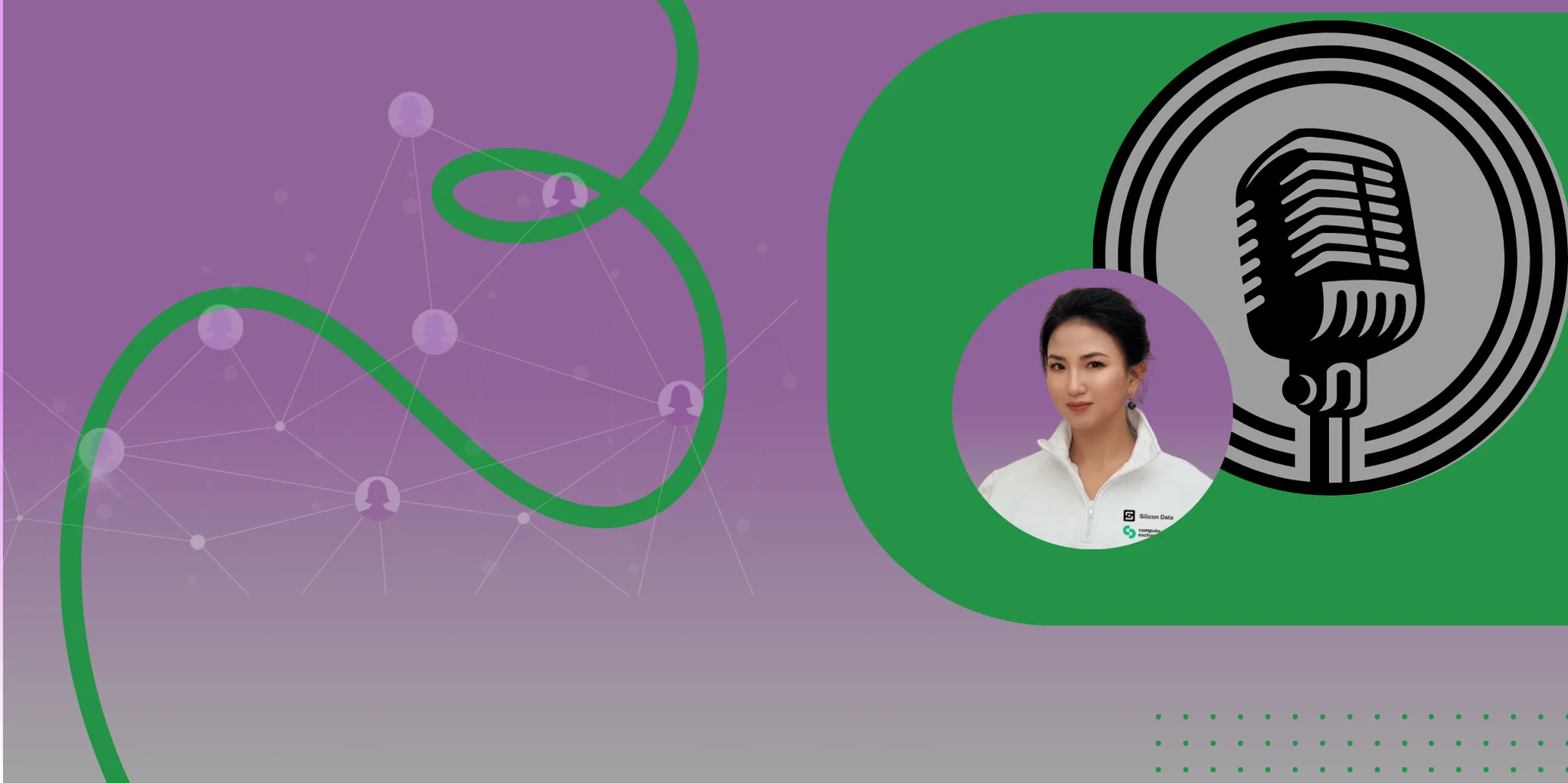
Just Saying No - Boundaries, Confidence and the Power of Choosing
23 November, 2026
No is a complete sentence
Marina Afonso on boundaries, bold communication and the keys we pass on to other women
Marina Afonso in conversation with host Holly Staff
“Saying no is like going to the gym. The first time, it’s hard and it’s uncomfortable. But as you train, it gets easier, and you become more confident.”
When Marina Afonso started her career in technology around 12 years ago, saying no did not feel like an option. She was shy, still learning English, which she only began studying in her twenties, and working in a field where she was often one of very few women. Every request felt like a test, and every yes felt like evidence that she deserved to be there.
“I could not say no because I thought I needed to prove myself all the time.”
Today, Marina is a technology and partnerships leader with more than a decade of experience across Latin America, and has led initiatives supporting women and promoting greater inclusion within a global technology company. Based in Brazil, she now sees saying no very differently. It is no longer a failure to deliver. It is a strategic decision about where her time and energy should go.
In the latest episode of The Women Behind the Network, Marina joins host Holly Staff to talk about setting boundaries, the habit of over-explaining, the invisible work women are so often expected to carry and why communicating with confidence is something you train for rather than something you are born with.
| Tune into the podcast to hear how a shy newcomer to tech who said yes to everything became a leader who now says no on purpose, and why she believes every woman is carrying a key she should be passing on. |
A muscle, not a personality trait
Why does saying no feel so uncomfortable? For Marina, it starts long before anybody walks into an office. From childhood, girls are often encouraged to be sweet, helpful and accommodating, so saying no can feel almost like breaking a rule.
That is why she thinks of it as a muscle. Nobody expects to walk into a gym for the first time and find it easy. Strength comes with repetition, and so does the confidence to decline.
The habit shows up in the smallest moments. Marina describes a situation most people will recognise: a friend invites you to a party you have no wish to attend. Instead of simply saying you would rather not go, you build an elaborate story about being tired, having an early meeting, feeling exhausted. At work, the same instinct turns into a long, apologetic email in response to a request you simply do not have capacity for.
"Instead of saying no, you put a load of excuses in the middle. You create a whole story just because you don’t want to go.”
The situation itself is simple. It is the guilt we attach to it that makes it feel complicated.
Why the no gets stuck
Culture plays a part. In Brazil, Marina explains, communication tends to be warm and indirect, so a direct no can be perceived very differently than it might be in the US or parts of Europe. Holding on to warm relationships while setting firm boundaries is a fine line to walk.
But the biggest barrier she sees is a global one: imposter syndrome. Many women worry that saying no will be read as a sign they cannot handle the pressure. Being the only woman in the room, which Marina notes still happens far too often, makes that worse. Without senior women to look to as examples, the pressure to say yes to everything and prove yourself above everybody else can be overwhelming.
“When you are the only woman in the room, the pressure to say yes is hard, because you need to prove yourself above everybody else.”
Holly recognises the pattern from her own career. Saying yes to everything to show that you can often means doing a worse job across the board, because you are stretched too thin to do anything well.
Stop negotiating with yourself
Marina recently finished Shonda Rhimes’s book, and one idea from it has become her mantra: no is a complete sentence.
“When you start over-explaining, you are giving the other person the right to negotiate with your boundaries.”
She understands where the habit comes from. In strategic meetings full of men, women’s decisions are often questioned more than their male colleagues’, so over-explaining becomes a kind of shield. But every extra justification is an invitation to push back.
The same applies to the way women open a point. Marina admits she has lost count of the number of times she started a meeting with “I could be wrong, but…” It is not a phrase she has ever heard from a male executive.
“You were hired because you have the experience. You are good at what you do.”
Of course anyone could be wrong. That is not a reason to start there.
| So what does she do instead? In the episode, Marina shares the simple swap she now makes in meetings, and why she would rather apologise afterwards than hold back her point at all. |
Ask why
Not every no has to be immediate. One of Marina’s simplest tools is a single question: why?
Why do you need me to do this? Why should it be my priority? Sometimes the answer confirms that the request does not make sense, and that gives you a clear basis to decline. Sometimes it changes your mind, because the work turns out to be important or will help you build a skill you do not yet have.
As Holly points out, most people are not asking in order to take advantage. Asking why simply puts the ownership back on them to consider whether the task really sits within your remit.
Boundaries also matter most at the start. Just a few months ago, Marina moved into a new AI-focused role, a deliberate step outside her comfort zone. It has brought enormous learning and confidence, but also a lot of nos. Without them, she says, she would be heading for burnout within a month.
“If I say yes to everything, I’m going to have a burnout in one month. So I need to prioritise.”
Whatever your level, junior or senior, your time is valuable.
Helpful is not the same as responsible for everything
There is another side to this. Women often become known as the person who will always step in, organise or support. That reliability is a strength, until it quietly becomes an expectation.
Marina had been discussing exactly this with friends over dinner. Too often, she believes, women’s goodwill is mistaken for obligation. Helping others is a beautiful thing, but it is not women’s job to carry the weight of the whole world on their shoulders.
“Helping is beautiful, and I do think helping is beautiful, but we need to put boundaries on that.”
She points to Viola Davis’s memoir, which she read with her book club of friends who share female authors from around the world. Even someone who appears so powerful spent years trying to please everybody and live up to other people’s expectations, including supporting her large family, before she learned to own her voice in her forties.
For Marina, the lesson is about courage: the courage to be bold, to own your career and to recognise that being available to everyone is not the same as being valuable.
The flip side is learning to ask for help yourself. Marina does it almost every day. Rather than spending two hours struggling with an unfamiliar tool, she will ask a colleague for five minutes. It saves time, strengthens relationships and often reveals a better way of working.
| Viola Davis’s story stayed with Marina long after she closed the book. On the podcast, she explains why, along with the dinner conversation with friends that made her rethink what women really owe everyone else. |
Balance is a choice you keep making
Marina is honest that for many years she focused only on her career and missed experiences in her personal life that she now regrets.
Today, she sees balance as something flexible rather than fixed. Some weeks, an important project will mean 12-hour days, and that is fine. Other days, she can start at 10am after a slow morning with a book. Sometimes personal life needs to come first, and sometimes you need time entirely for yourself.
“For me, balance is a powerful, almost magical word. It’s not easy, and it took me a lot of years to learn.”
What makes it work is knowing what makes you happy. For Marina, that is time with her husband, good food and travel, including trips on her own with nothing but a book. When the hard work is clearly leading somewhere you care about, the sacrifices feel easier to make.
As Holly reflects, it all comes back to boundaries. Without them, it is easy to get swept along by everyone else’s priorities. With them, balance becomes far easier to protect.
The patterns that hold women back
After years of supporting women professionally, Marina sees three patterns again and again.
The first is accepting a compliment. Tell a woman you like her top and she will often explain that it was in the sale, or that it only cost a few pounds. Marina’s answer is simple: if no is a complete sentence, so is thank you.
The second is imposter syndrome, particularly when it comes to applying for roles. Women often wait until they meet almost every requirement, while men are far more willing to apply with only some of them. Marina shares a Brazilian saying that captures the alternative mindset: you already have the no, so go and look for the yes.
The third is avoiding difficult conversations and direct, constructive feedback, often out of fear of no longer being seen as the nice, easy-going person in the room.
She would add one more: the fear of saying “I don’t know.” In a world moving as quickly as AI, Marina points out that two weeks of holiday can be enough for products, strategies and plans to change. Nobody can know everything. Saying “Good question, let me find out and come back to you” is far more credible than trying to talk around an answer you do not have.
“It’s okay to say I don’t know. Let’s figure it out together.”
| Marina and Holly compare notes from Brazil to the UK and beyond, and discover just how universal these habits are, with plenty of laughter about how hard two simple words can still be. |
Confidence comes from doing, and from being yourself
Marina now gives dozens of presentations a year, around 30 in the last year alone, and she does not always feel confident before she starts. Her advice is to go anyway: if you are afraid, go afraid.
What she has learned is that confidence cannot be borrowed. Trying to present like somebody else only makes you more anxious about getting it wrong. Marina likes to bring humour into the room, so she does, and that authenticity has helped her build her own personal brand.
She also asks for feedback whenever she can, often asking a trusted colleague or manager in the room to watch for what she could improve. Some of that feedback has been positive and some less so, but she credits it with getting her to where she is today.
Holly recognises the same lesson from her own experience of putting off speaking in front of her company, until she finally did it and realised she could. Self-belief, they agree, cannot be built by waiting to feel ready. It comes from proving to yourself that you can.
Above all, Marina encourages women to invest in themselves through training, learning, reading and building their network. Much of it is free, and it does not need a manager’s permission.
“You will never regret investing in yourself.”
There’s also the birthday gift Marina is using to sharpen her presentation skills, and the story of the company-wide talk Holly put off for months, until she finally didn’t.
Keep a key in your pocket
At a recent event, a woman shared an idea with Marina that she has been passing on ever since. Everybody carries a key. As we grow in our careers, we have a responsibility to hand those keys to other women so they can open doors of their own.
Marina knows how many doors other women have opened for her. Now, she sees it as her responsibility to do the same, and that is why, when a woman messages her on LinkedIn asking for advice, she will almost always make time to help.
“If I’m here, it’s because a lot of women helped me to get here. So it’s my responsibility to help them as well.”
It is something Holly hears from almost every guest on the podcast: established women want to support others, they simply do not always know how to find them. The assumption that someone will not want to help is usually one we place on ourselves.
So be a little braver. Send the message. If the answer is no, ask the next person. As Marina says, you already have the no.
Holly shares how one former guest turned this idea into a mentoring group of her own, and why the women you admire from a distance may simply be waiting for you to get in touch.
Better every day
Marina is optimistic. Compared with the generations of women before us, she believes there has already been real progress, and she sees it continuing step by step. One per cent better every day soon adds up.
“Of course there is a lot of room to keep improving, but it’s step by step. Today, we are better than yesterday.”
Her own story shows that boundaries are not about doing less. They are about choosing what deserves your energy, speaking with clarity, asking for what you need and making room to lift others as you climb.
The first no may be hard. The next one will be a little easier.
Listen to the conversation
In the latest episode of The Women Behind the Network, Marina Afonso joins host Holly Staff to discuss saying no, setting boundaries and how communicating with greater confidence can shape our careers.
They explore imposter syndrome, over-explaining, the invisible work women are often expected to take on, asking for help and feedback, finding balance, authenticity in public speaking and why every woman has a key to pass on.
Tune into the podcast to find out why the first no is the hardest, why “thank you” deserves to stand on its own and what Marina would tell her younger self.
Related Posts
Rekha Shenoy - Episode 179 - The Route to Networking
22 September, 2026
The Power of Ambition: Building Capability, Influence and Impact
25 August, 2026