Rekha Shenoy - Episode 179 - The Route to Networking
22 Sept, 2026


The Infrastructure Beneath the Surface: Why Subsea Networks and Ocean-Based Energy Are Gaini...

We recently had Nathaniel Harmon, Co-Founder and CEO of OceanBit, on The Route to Networking podcast.
His work sits at the intersection of energy, subsea infrastructure, and high-performance computing. But what stood out wasn’t just the technology itself.
It was how differently he thinks about where digital infrastructure should exist.
Because while most of the industry is focused on building bigger, faster, and closer to cities, Nathaniel is looking in the opposite direction.
Out to sea.
One of the most interesting parts of the conversation was realising that the core technology behind this isn’t actually new.
Ocean thermal energy has been around for decades. In fact, large parts of the development happened back in the 70s and 80s.
But it never really took off.
Not because it didn’t work, but because the world around it wasn’t ready.
As Nathaniel explained, projects were stuck in a loop. Each one had to be designed for a specific location, a specific grid, a specific demand.
“If that project falls through… you’re back to square one.”
So despite the potential, it stayed on the edge of the industry.
Until now.
At its core, ocean thermal energy is relatively straightforward.
It uses the temperature difference between warm surface water and cold deep ocean water to generate power. Think of it as a natural heat engine, constantly running.
What makes it different is consistency.
Unlike solar or wind, it doesn’t depend on weather conditions. It provides continuous, baseload energy.
But the real shift isn’t the energy itself.
It’s how it’s being used.
Originally, the focus was on exporting that energy back to land.
Which makes sense. That’s how most power infrastructure works.
But it comes with limitations.
So the thinking changed.
Instead of asking how to move power to land, the question became:
What if you didn’t have to?
Nathaniel described this shift through the lens of high-performance computing.
Early on, the idea was to use computing as a way to absorb excess energy. At the time, that meant Bitcoin mining.
“You just plug in computers and feed it electricity… and it generates revenue.”
But that idea evolved quickly.
Because once AI workloads arrived, the demand for compute exploded.
And suddenly, the model made even more sense.
This is where subsea infrastructure becomes a key part of the story.
One of the simplest but most powerful points Nathaniel made was this:
"Transporting data is far easier than transporting power".
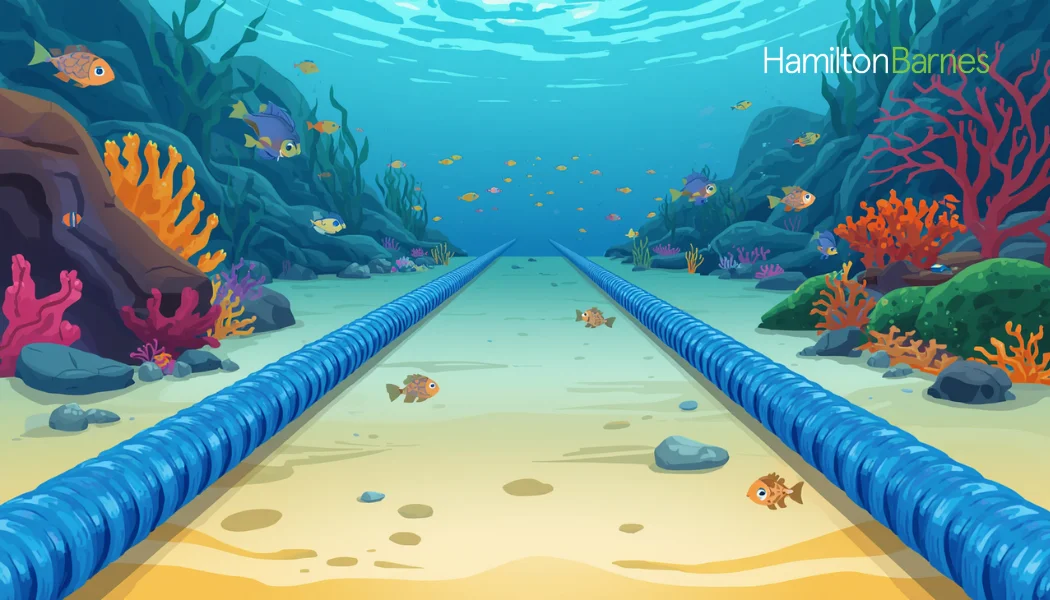
Subsea cables already carry the majority of global internet traffic. They connect continents, support cloud platforms, and enable everything from streaming to financial systems.
But we rarely think about them.
They sit quietly on the ocean floor, doing the heavy lifting behind the scenes.
And importantly, they are far more flexible than power infrastructure.
So if you combine offshore energy with subsea data networks, you start to unlock something new.
Infrastructure that doesn’t need to sit on land at all.
If the idea is this compelling, the obvious question is:
Why hasn’t it already taken off?
The answer is a mix of perception and practicality.
For a long time, offshore infrastructure has been seen as more complex. Higher risk. More difficult to manage.
Nathaniel compared it to the early days of the oil industry, where companies were hesitant to move offshore until they were forced to.
And when they did, they realised something important.
It was actually more efficient.
“There’s this pervasive myth that working offshore is somehow more expensive… but it’s just not true.”
At the same time, the demand simply wasn’t there.
Without a constant, scalable consumer of energy, the economics didn’t stack up.
Now, with AI and high-performance computing, that has changed.
One of the more thought-provoking parts of the conversation was how Nathaniel framed the ocean itself.
Not just as a location.
But as a resource.
“The ocean is the largest untapped resource that we have available.”
It offers space, cooling, and energy potential at a scale that is difficult to match on land.
And as pressure builds on traditional infrastructure, those advantages become more relevant.
The ocean solves all three.
This isn’t about replacing everything overnight.
But it does challenge a core assumption.
That digital infrastructure has to be built on land.
What Nathaniel’s work highlights is that this doesn’t necessarily have to be the case.
It’s a different way of thinking.
And one that feels increasingly relevant as demand continues to grow.
We’re still early.
But the direction of travel is clear.
As infrastructure becomes more constrained on land, alternative models will start to gain traction.
And offshore infrastructure sits firmly in that category.
Nathaniel’s view is that the ocean represents one of the largest untapped opportunities for both energy and digital infrastructure.
If that’s the case, it raises a bigger question.
If we can generate power offshore, cool infrastructure naturally, and move data more efficiently than energy…
Why does everything still need to sit on land?
Because behind every digital service is a physical system.
And that system may not always sit where we expect it to.
What do you think?
Hamilton Barnes supports organizations and professionals across the global data center and digital infrastructure market, helping businesses navigate the challenges of scaling, hiring, and delivery.
We work closely with companies across networking, fibre, telecommunications, and data center infrastructure to secure the talent needed across engineering, construction, and operations. As the industry continues to evolve, we help businesses build the teams required to deliver, and support professionals in positioning themselves within a fast-moving and increasingly complex market.
We also support candidates with CV guidance, interview preparation, and long-term career planning, helping you position yourself in a fast-moving and competitive market.
If you’re looking to discuss your hiring plans or explore your next career move, our team is always available for a conversation.
Want to hear more from the Route to Networking podcast?
What is ocean thermal energy?
Ocean thermal energy uses the temperature difference between warm surface water and cold deep water to generate continuous, renewable power.
Is ocean thermal a new technology?
No. It has existed for decades, but is only now becoming more relevant due to changes in infrastructure demand.
What are subsea cables?
Subsea cables are fibre optic cables laid on the ocean floor that carry most global internet traffic.
Why combine energy and infrastructure offshore?
It allows infrastructure to be built closer to energy sources, reducing reliance on land, lowering cooling costs, and increasing efficiency.
Why isn’t this more widely used yet?
Adoption has been limited by geography, perception of offshore risk, and historically low demand. That is now starting to change.